
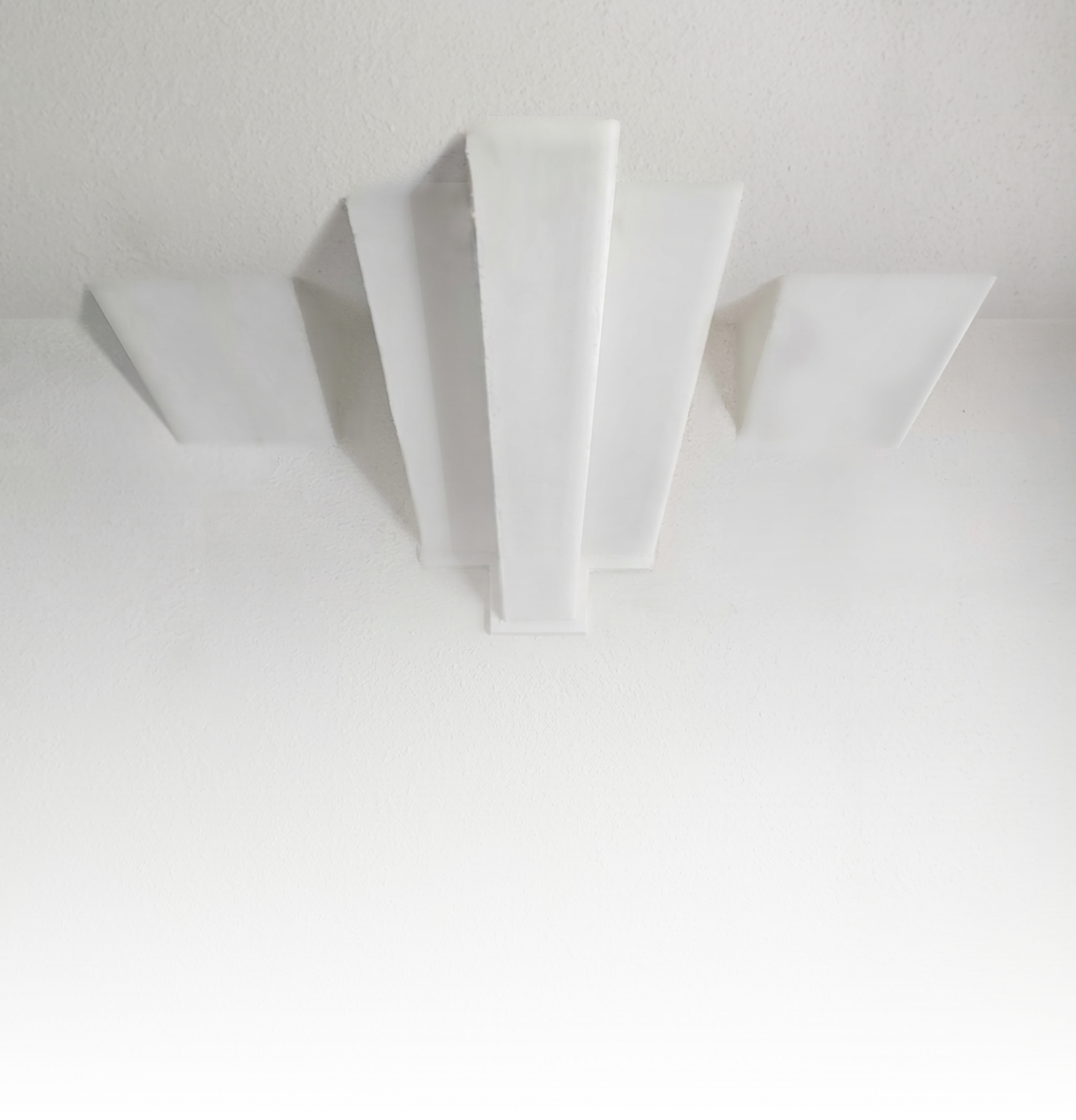
Low-end problems are some of the hardest to fix in any room, and ours was no exception — measurements revealed clear frequency build-ups in the rear ceiling corner, a classic spot for room modes to gather and muddy the bass. Rather than buy an off-the-shelf solution, we decided to design and build our own quadratic residue diffuser (QRD) for that exact corner.
The design followed the maths closely. A QRD works by creating reflective wells of carefully calculated depths, based on quadratic residue sequences, so that reflected sound is scattered evenly across time and angle rather than bouncing straight back. We kept the well bottoms flat — true to the QRD principle — since any curvature would smear the phase relationships the design depends on.
For our space, we built the diffuser as a ramp at a 20° angle with 50 cm deep wells, working out the geometry with simple trigonometry to get a horizontal run of roughly 1.37 metres — long enough to do its job, short enough to fit our 3.6 m room without dominating it. A small air gap behind the panel, lined with rockwool, adds extra absorption in the low-mids where the diffuser itself can't help.
The result is a corner that no longer fights us — reflections are scattered rather than slamming straight back at the listening position, and low-end decisions made in this room now hold up when they're played back on a proper club rig.