
Ableton’s subtractive synthesiser
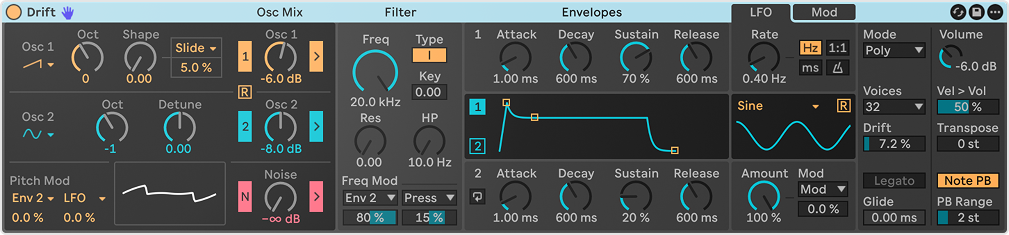
Drift is Ableton’s most approachable synthesiser and is included in every edition of Live, so it’s often the first synth people learn. It’s a classic subtractive design: two oscillators and a noise generator, shaped by a filter and envelopes. The interface keeps everything on one panel with no hidden pages. Its signature is the Drift control. It adds slight, random variation to the pitch and filter of each voice, so chords breathe and wobble like an old analogue polysynth rather than sitting perfectly still. Two filter types cover both warm, saturated sweeps and smoother, more controlled resonance. A cycling envelope and a flexible LFO keep sounds moving. Drift is also very light on CPU and fully supports MPE. It’s especially good for warm pads, plucky basses and vintage-sounding leads. Drift is included in all editions of Live.
Features
Two oscillators, including the exclusive Shark Tooth and Saturated waveforms
Shape control that morphs each waveform, with its own modulation source
Noise generator mixed alongside the oscillators
Oscillator mixer with gain levels that push the filter into analogue-style saturation
Low-pass filter with two types: Type I (12 dB) and Type II (24 dB)
High-pass filter and key tracking
Two envelopes, with the second switchable to a cycling envelope
LFO with nine waveforms, including Wander and one-shot envelope shapes
Mod section with three free slots routable to most parameters
Four voice modes: Poly, Mono, Stereo and Unison, with up to 32 voices
Drift control for per-voice pitch and filter variation
Legato and glide in Mono mode
Full MPE support for pressure, slide and per-note pitch bend
Great for
Warm pads
Plucky basses
Vintage leads
Detuned chords
Expressive MPE playing
Related articles
Analog · Wavetable · Operator · Simpler · Chorus-Ensemble · Auto Filter